Hoy en "Diario AZprensa" puedes leer...

Showing posts with label Saturn. Show all posts

Wednesday, May 28, 2025

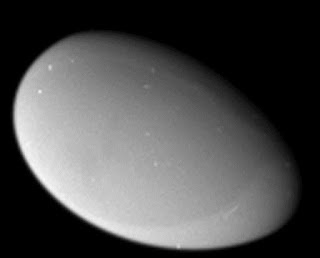
The largest "egg" in the world


It’s called Methone (or Metone), a small, egg-shaped rocky satellite with a diameter of just 3 kilometers, orbiting within our solar system. Located 194,000 km from Saturn, its orbit experiences oscillations of about 20 km due to the gravitational influence of the nearby moon Mimas.

Another distinctive feature of this “space egg” is that, among all the rocky satellites in our solar system, it appears to have the smoothest surface. Also known as Saturn XXXII, Methone completes one orbit around Saturn in a single day.
 

A journey through the history of the pharmaceutical industry and one of its great laboratories that had its origins in Alfred Nobel...
“From Alfred Nobel to AstraZeneca”: https://a.co/d/9svRTuI

Sunday, April 20, 2025

Enceladus has a warm heart

Until recently, active volcanism was known to exist only on two planets, Venus and Earth, and on Jupiter’s moon Io. However, it has now been confirmed that Enceladus, a moon of Saturn, also exhibits this phenomenon.

This satellite orbits Saturn at a distance of 238,040 km, doing so synchronously (always showing the same face) in 32.9 hours. It is nearly spherical, with a diameter of 499 km, and its icy surface displays remarkable diversity: some regions are almost smooth, devoid of geological features, while others show fracture lines from tectonic activity, and still others are dotted with impact craters. The most striking feature, however, lies at its South Pole.
 
There, scientists have identified what they’ve dubbed “tiger stripes”—grooves stretching 130 km long, 2 km wide, and 500 meters deep. From these, massive jets of water vapor, solid materials like sodium chloride crystals and ice, volatile compounds, and—surprisingly—organic material are continuously ejected into space at a rate of up to 200 kg per second. The Cassini spacecraft, which explored this moon, detected over 100 such geysers, confirming the presence of an internal heat source. The concentration of this activity at the South Pole may be due to centrifugal forces pushing denser material toward the equator and lighter material toward the poles. Some of the expelled water vapor falls back as snow, while the rest escapes, contributing to Saturn’s outermost and faintest E ring, within which Enceladus orbits.
 
This internal heat source drives volcanoes and hydrothermal vents, similar to those found on Earth’s ocean floors. Beneath its icy surface, Enceladus harbors a liquid water ocean about 30 km deep and 10 km thick, situated above its central core. Yet, there may be additional, unknown heat sources at play. For instance, Enceladus is in an orbital resonance with its neighboring moon Dione (completing two orbits around Saturn for every one of Dione’s), which helps maintain its orbital eccentricity and generates extra heat through geological activity. Between these factors, scientists are left astounded—especially upon discovering that the heat output at the South Pole reaches nearly 16 million watts, ten times higher than previously estimated, with no clear explanation yet uncovered.
 
At the surface, Enceladus is blanketed in ice, with an average temperature of -198°C. This varies by location and time, ranging from -240°C to -128°C—except, of course, in the South Pole regions where the constant geysers emerge.
 
Its atmosphere consists of water vapor (91%), nitrogen (4%), carbon dioxide (3.2%), and methane (1.7%). This composition, along with its subsurface ocean and hydrothermal activity, has sparked significant scientific interest, positioning Enceladus as one of the most promising locations in our solar system for potential life, particularly near its hydrothermal vents.
 

A journey through the history of the pharmaceutical industry and one of its great laboratories that had its origins in Alfred Nobel...
“From Alfred Nobel to AstraZeneca”: https://a.co/d/9svRTuI

Saturday, April 19, 2025

The "Death Star" does exist

Many people have compared Mimas to the “Death Star” from the movie Star Wars due to its striking resemblance. Although it is not a perfect sphere—being somewhat deformed by Saturn’s gravitational pull—one of its sides stands out with an enormous crater, Herschel, measuring 130 km in diameter, mirroring the proportions and position seen in the film. Considering that the average diameter of this moon is 397 km, the crater’s immense size becomes clear, as evidenced by the fracture lines on the opposite side of the satellite, a result of the tremendous impact that created it. The frigid temperature of its surface (-209°C) seems fitting for its “Death Star” likeness, as does its low reflectivity (albedo of 0.07).

One peculiar feature of this moon is the wobble it exhibits around its polar axis, suggesting that its interior is not uniform. Some speculate that it may have a melon-shaped rocky core, while others propose the existence of an internal ocean beneath a layer of ice, approximately 25 to 30 km thick, which could partially explain this wobbling motion.
 
Beyond the Herschel crater, Mimas’ surface has reached a point of saturation, meaning any new asteroid impact would inevitably strike one of the countless craters already covering it. While it’s uncertain whether Mimas experienced geological activity in the past, it displays very ancient grooves, about 1 km deep, which might hint at such internal processes. Across its rugged terrain, some craters have walls rising up to 4 km high, containing dusty material likely produced by landslides. 

Additionally, despite the prevailing cold, not all areas of the surface share the same temperature, with some regions detected as being slightly less frigid.

Mimas orbits Saturn at a distance of 185,520 km and is tidally locked, always presenting the same face to the planet. It completes one orbit in nearly a day (22.5 hours). Its gravity, meanwhile, is a mere 0.07.
 
Finally, it’s worth noting a curious role Mimas plays: it helps clear particles from the gap between Saturn’s A and B rings.
 

A chance encounter will take him far away, on a thrilling adventure full of action and emotion that will change his life... but also the lives of everyone around him…
“Fleeing into silence”: https://a.co/d/7SUfVb3

Thursday, April 10, 2025

Saturn and its satellites

In addition to the classic rings that surround Saturn, this planet has an enormous cohort of satellites orbiting it—not as many as Jupiter, but still a significant number. So far, 62 of them have been identified (though many are quite small), and this list continues to grow year by year. The most notable ones due to their size are: Titan (5,150 km in diameter), Iapetus (1,560 km), Rhea (1,528 km), Dione (1,120 km), Tethys (1,060 km), and Enceladus (496 km).

The complete list, ordered by distance from Saturn, is as follows, including their size and orbital period (those marked with a minus sign indicate they rotate in a retrograde direction):
 

Satéllite

Distance from Saturn (Km.)

Diámeter (Km.)

Orbital period (days)

S/2009 S1

117.000

0,3

0,4

Pan

133.600

20

0,5

Dafne

137.000

6,5

?

Atlas

137.670

37x34x27

0,6

Prometeo

139.350

48x100x68

0,6

Pandora

141.700

110x88x62

0,6

Epimeteo

151.420

194x190x154

0,6

Jano

151.470

138x110x110

0,6

Egeón

167.500

0,5

0,8

Mimas

185.540

415x394x381

0,9

Metone

194.000

3

1,0

Anthe

197.700

2

1,0

Palene

211.000

4

1,1

Encélado

238.040

499

1,3

Tetis

294.670

1.046

1,8

Telesto

294.670

30x25x15

1,8

Calipso

294.670

30x16x16

1,8

Dione

377.420

1.118

2,7

Helena

377.420

36x32x30

2,7

Pollux

377.396

3,5

2,7

Rea

527.040

1.528

4,5

Titán

1.221.850

5.150

15,4

Hiperión

1.464.100

360x280x225

21,2

Jápeto

3.561.300

1.436

79,3

Kiviuq

11.365.000

14

449,2

Ijiraq

11.442.000

10

451,4

Febe

12.952.000

230x220x210

550,4

Paaliaq

15.198.000

20

686,9

Skadi

15.641.000

6

728,1

Albiorix

16.394.000

26

783,4

S/2007 S2

16.560.000

6

-792,9

Bebhionn

17.153.520

6

838,7

Skoll

17.473.800

6

-862,3

Erriapo

17.604.000

8

871,2

Tarqeq

17.910.600

7

894,8

S/2004 S13

18.056.300

6

-905,8

Greip

18.065.700

6

-906,5

Hyrokkin

18.168.300

8

-914,2

Siatnaq

18.195.000

32

895,5

Tarvos

18.239.000

15

926,1

Jarnsaxa

18.556.900

6

-943,7

Narvi

18.719.000

7

956,1

Mundilfari

18.722.000

6

951,5

S/2006 S1

18.930.200

6

-972,4

S/2004 S17

19.099.200

4

-985,5

Bergelmir

19.104.000

6

-985,8

Suttungr

19.465.000

6

1.016,5

Hati

19.709.300

6

-1.033,0

S/2004 S12

19.905.900

5

-1.048,5

Farbauti

19.984.800

5

-1.054,7

Thrymr

20.219.000

6

1.091,7

Aegir

20.482.900

6

-1.094,4

S/2007 S3

20.518.500

5

-1.100,0

Bestia

20.570.000

7

-1.101,4

S/2004 S7

20.576.700

6

-1.101,9

S/2006 S3

21.076.300

6

-1.142,3

Fenrir

21.930.644

4

-1.212,5

Surtur

22.288.916

6

-1.242.5

Kari

22.321.200

7

-1.245,0

Ymir

22.429.673

18

-1.254,1

Loge

22.984.322

6

-1.300,9

Fornjot

24.504.879

6

-1432,1


A journey through the history of the pharmaceutical industry and one of its great laboratories that had its origins in Alfred Nobel...
“From Alfred Nobel to AstraZeneca” (Vicente Fisac, Amazon) is available in e-Book and print editions: https://a.co/d/9svRTuI